The spine of Referna is the next client. The product keeps forgetting it.
A walk through the member journey, aligned around the next client. The onboarding section proposes a broader flow change. Elsewhere, real Today screenshots sit alongside Proposed screens — roughly 80% identical, with the spine-aligned 20% changed.
02
The frame
Every service has a spine — the one promise everything else must ladder up to.
"Figure out the spine of your service offering. Then check whether the product actually follows it — that's where most products fail."
— the CPO frame this exercise started from
Referna's spine
We help independent professionals land their next client by matching them into referral circles.
The golden goose is the next client. Circles, matches, meetings, points — all of it is scaffolding. A member who sits through every ritual and never gets closer to a client has been failed, however good the meetings felt.
03
The audit — what the product says today
The promise is made at the door and delivered in the room. It is lost everywhere in between — and after.
Surface
Grade
Evidence
Homepage
A
"Your next tech client is a referral away." — the H1 itself
Onboarding
B
Maps your ideal client deeply; the give side is one optional step
Matches page
C
"12 of their clients match your ICP" — a number invented by a hash function
Meetings page
C
Coverage checkmarks per topic; the named lead in the same record is never shown
Circle page
C
Charter, cadence, points; business value appears only after the fact
Emails
D
"Your 3 new recommended peers are ready" — no subject names a client
Community email
D
"The Referna community is growing" — headcount, never client reach
Surface
Grade
Evidence
Cohort roster
D
"Meet whoever looks interesting." — an attendance sheet
Live 1:1
A
"Name one real person you'd refer to the other." — every call
Cohort group sessions
B
"When would you refer each other?" is on the agenda — never banked
The Mixer
B
Same call-sign rounds as the 1:1 — but drops the name-a-lead round
Follow-up 1:1s
F
No follow-up flow — a repeat meeting re-runs the first-meeting script
After the meeting
F
The named lead is recorded — then nothing ever happens to it
04
The numbers — what's already sitting in our own data
The client list already exists. We never collected it — and it evaporates the moment it's spoken.
Client-company relationships mapped this week from 372 members' calendars, onboarding answers, matching profiles, and meeting summaries — deduped, then verified against a real company graph.
5,256
real, deduped companies mapped — from 11,488 raw contact mentions, 372 members
1,073
confirmed tech / startup companies (20%) — the rest are non-tech, or not yet checked
786 US
239 Israel · 257 international — geography confirmed so far
9 / 1
median real companies per member — only 1 is a confirmed tech client
16 / 99
1:1 calls with a named lead recorded — and tracked to zero after
The reframe
The unit of progress is not a meeting held. It is a client opportunity in motion.
05
The engine
Two halves: where the client list comes from, and where it gets shown.
1 — Retrieving
In onboarding
Members already type client names into a free-text field. Today: optional, one step out of ten.
Needed: discover connections from supplied materials; ask for one credible give-side connection in the guided get / give loop. Additional sources stay optional.
When a member requests a meeting
A member wants to name a contact before asking for someone's time. Today: not built.
Needed: confirm relevant give-side connections before a match request. The first guided round also requires calendar free/busy so an accepted match can become a meeting.
During live calls
Members already say client names out loud on every call. Today: captured in prose, in a recap no one parses.
Needed: extracted live and shown as chips (surface 4).
2 — Surfacing
On the matches page
A member wants to see which of the other person's clients fit their own target market before deciding to meet.
Needed: the overlap leads the card, not the person's title (surfaces 2, 2.1).
On the roster and circle pages
A member wants to know, at a glance, who in the room can reach their target companies.
Needed: reach ranks the list; logos back every claim (surfaces 7, 8).
In the recap and on the meetings page
A member wants to see, after a call, exactly which clients were named and by whom.
Needed: the same "you / they mentioned" split everywhere (surfaces 4, 5, 6).
06
The product loop · Find your next client. Help them find theirs.
One useful match teaches the whole loop.
Create appetite with companies the user wants to reach, then make a relationship possible through a specific contribution.
01
See who you could reach
Choose visual company buckets. Discover a few people connected to potential next clients.
→
02
Show how you can help
Confirm a relevant connection. Finish the profile that explains your mutual value.
→
03
Request a relationship
Propose a time to build trust. Continue finding opportunities while the request is pending.
↻ Recommendations repeat the same path: opportunity → contribution → relationship
Three initial questions are a starting hypothesis. The first match request is the milestone; question depth can evolve after trying the concept.
Optional materials prepare a draft while the member chooses clients.
Find your next client.Interactive concept
Concept only · Real company logos; bucket assignments, counts, people and connections are illustrative. No request is sent.
Onboarding concept · Choose clients · 1 of 3
Make the opportunity visible in every answer.
Each bucket contains recognizable companies and the scale of the opportunity.
Find your next client.Interactive concept
Concept only · Real company logos; bucket assignments, counts, people and connections are illustrative. No request is sent.
Onboarding concept · Choose clients · 2 of 3
Narrow the companies without losing the appetite.
A second visual choice puts company scale in context.
Find your next client.Interactive concept
Concept only · Real company logos; bucket assignments, counts, people and connections are illustrative. No request is sent.
Onboarding concept · Choose clients · 3 of 3
Get to useful people as soon as we have a starting point.
Three questions are an initial hypothesis; we can add questions if the matches need more precision.
Find your next client.Interactive concept
Concept only · Real company logos; bucket assignments, counts, people and connections are illustrative. No request is sent.
Onboarding concept · Find mutual value
Show the first people worth meeting now.
A few target logos lead directly to the members who could help the user reach them.
Find your next client.Interactive concept
Concept only · Real company logos; bucket assignments, counts, people and connections are illustrative. No request is sent.
Onboarding concept · Find mutual value
Make the contribution specific to this member.
The chosen target company stays in view while the user confirms what they can offer.
Find your next client.Interactive concept
Concept only · Real company logos; bucket assignments, counts, people and connections are illustrative. No request is sent.
Onboarding concept · Review profile
Complete the profile for a person the user wants to meet.
Show what the recipient will see, with the first contribution already included.
Find your next client.Interactive concept
Concept only · Real company logos; bucket assignments, counts, people and connections are illustrative. No request is sent.
Onboarding concept · Request meeting
Choose the time and send the first match request.
Calendar availability makes it easy to propose a time as part of the request.
Find your next client.Interactive concept
Concept only · Real company logos; bucket assignments, counts, people and connections are illustrative. No request is sent.
Onboarding concept · Matching
The first request leads straight into recommendations.
Show the pending request and continue the same loop inside the product.
Find your next client.Interactive concept
Concept only · Real company logos; bucket assignments, counts, people and connections are illustrative. No request is sent.
✱ Updated direction · Headquarters model · 1 / 11
Your next-client headquarters
One home for finding your next client and helping someone else find theirs. Its priorities change as your network becomes useful.
✱ Updated direction · Headquarters variations · 2 / 11
Growing a referral network
I need people who could help me reach my next clients. Show me why we are worth meeting and how I could help them.
✱ Updated direction · Headquarters variations · 3 / 11
An active cohort
I have joined and attended. Now I need to make this group useful: clarify my ask, help others and build trust between weekly meetings.
✱ Updated direction · Headquarters variations · 4 / 11
An established 1:1 network
I have relevant, trusted partners without a cohort. Help us remember each other’s signals and act on the relationships we already have.
✱ Updated direction · User situations · 5 / 11
A partner knows a company I want to reach
I need them to remember the right signal. In return, I need a clear, realistic way to keep an eye out for their next client.
✱ Updated direction · User situations · 6 / 11
I am not yet comfortable making a referral
I may trust a partner for one kind of work but need more evidence for another. Help me choose what would make a referral comfortable, or pause the relationship.
✱ Updated direction · User situations · 7 / 11
Which new relationship would add something?
I already have trusted partners. Help me fill a gap without undermining those relationships. In a cohort, that could also help fill an open service seat.
✱ Updated direction · User situations · 8 / 11
I have received help, but left others waiting
Show me the commitments I need to act on and a useful way to contribute. Continued taking without participation should gradually limit new asks.
✱ Updated direction · Cohorts & 1:1s · 9 / 11
The weekly cohort meeting and the work around it
I want this week’s room to move opportunities forward. Bring a sharper ask, learn who needs help, then follow through and return with updates.
✱ Updated direction · Cohorts & 1:1s · 10 / 11
Deeper trust with everyone in the cohort
The weekly room keeps us connected. Periodic 1:1s help me understand each member’s work. Referna helps with whom to meet, the purpose and a shared time.
✱ Updated direction · Cohorts & 1:1s · 11 / 11
A useful agenda for this relationship, today
A first meeting starts our story. The next one should build on what we learned, what changed and what we agreed to do, whether we share a cohort or met individually.
Earlier material · Retained for reference
Recommendations, cohorts and meetings
The earlier concepts and source screens stay together here, with their original IDs and review comments. The updated chapter above guides the current direction where proposals differ.
The cohort stays prominent. A person waiting on you—or a meeting starting soon—can take priority.
Find your next client.✱ Proposed experience
Independent demo scenarios · People, counts and connections are illustrative. No live actions.
✱ New concept Recommendations · 2 / 8
Sell the cohort through the clients in the room.
One seat per primary service. The opportunity is the people who could help you reach relevant clients.
Find your next client.✱ Proposed experience
Independent demo scenarios · People, counts and connections are illustrative. No live actions.
✱ New concept Recommendations · 3 / 8
Earn a place by helping the room find its next clients.
Show the cohort’s asks, reuse known connections, and confirm specific contributions.
Find your next client.✱ Proposed experience
Independent demo scenarios · People, counts and connections are illustrative. No live actions.
✱ New concept Recommendations · 4 / 8
Make existing trust useful before chasing more introductions.
Relevant clients, reciprocal asks, and one contextual next step keep a relationship warm.
Find your next client.✱ Proposed experience
Independent demo scenarios · People, counts and connections are illustrative. No live actions.
✱ New concept Recommendations · 5 / 8
Give the client, the person, and their ask equal weight.
A credible reason to invest now: relevant access, reciprocal potential, timing, and compatibility.
Find your next client.✱ Proposed experience
Independent demo scenarios · People, counts and connections are illustrative. No live actions.
✱ New concept Recommendations · 6 / 8
An incoming request is a concrete reason to respond.
The sender’s contribution and proposed time arrive with the request. The recipient does not redo onboarding.
Find your next client.✱ Proposed experience
Independent demo scenarios · People, counts and connections are illustrative. No live actions.
✱ New concept Recommendations · 7 / 8
Show what is waiting, what is booked, and what needs action.
Keep commitments compact. A proposed time is not a confirmed meeting.
Find your next client.✱ Proposed experience
Independent demo scenarios · People, counts and connections are illustrative. No live actions.
✱ New concept Recommendations · 8 / 8
The loop succeeds when a useful relationship moves forward.
New possibilities create appetite. A specific contribution, a kept commitment, or renewed trust makes the network more useful.
Find your next client.✱ Proposed experience
Independent demo scenarios · People, counts and connections are illustrative. No live actions.
22
Before / after · Surface 2
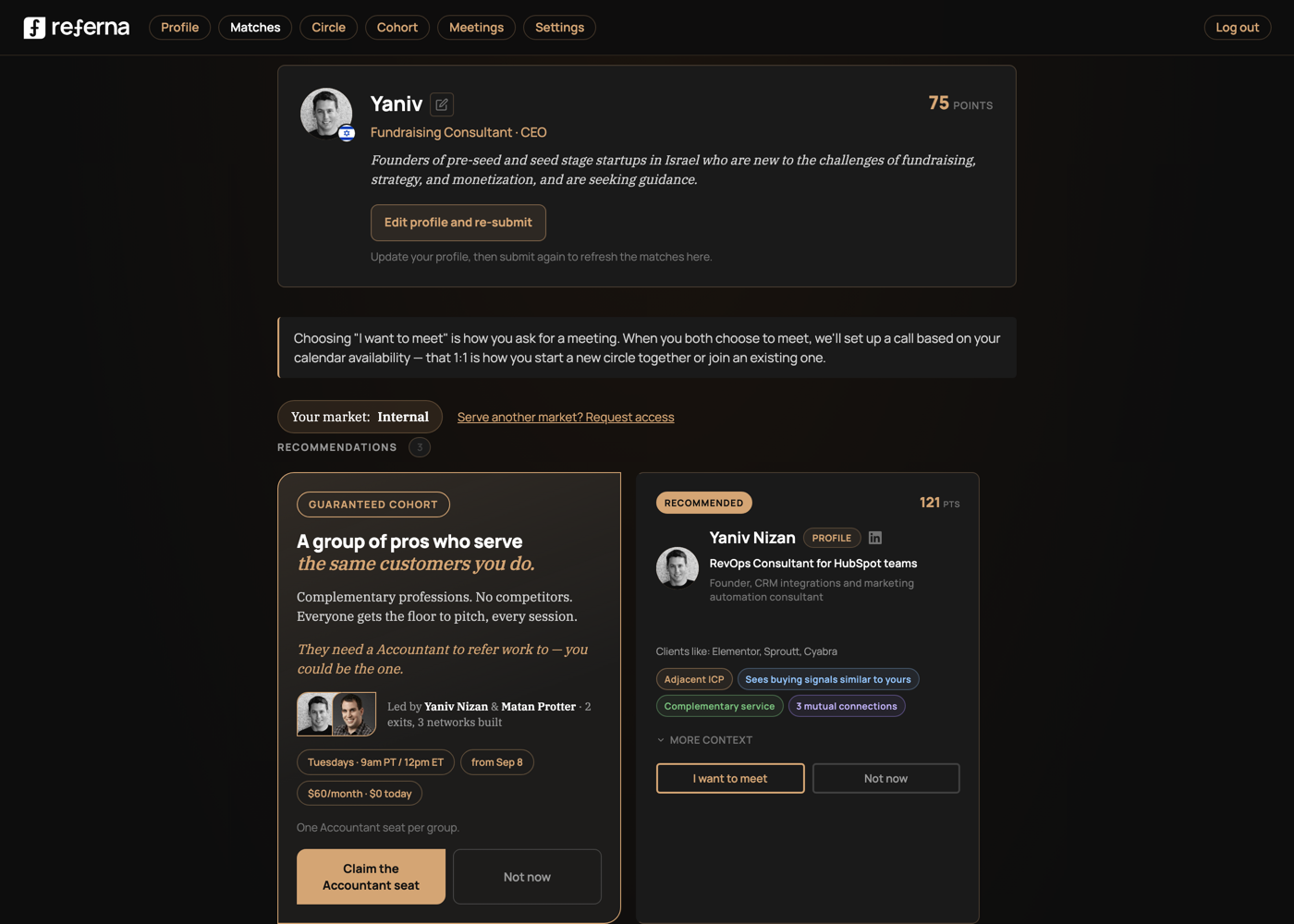
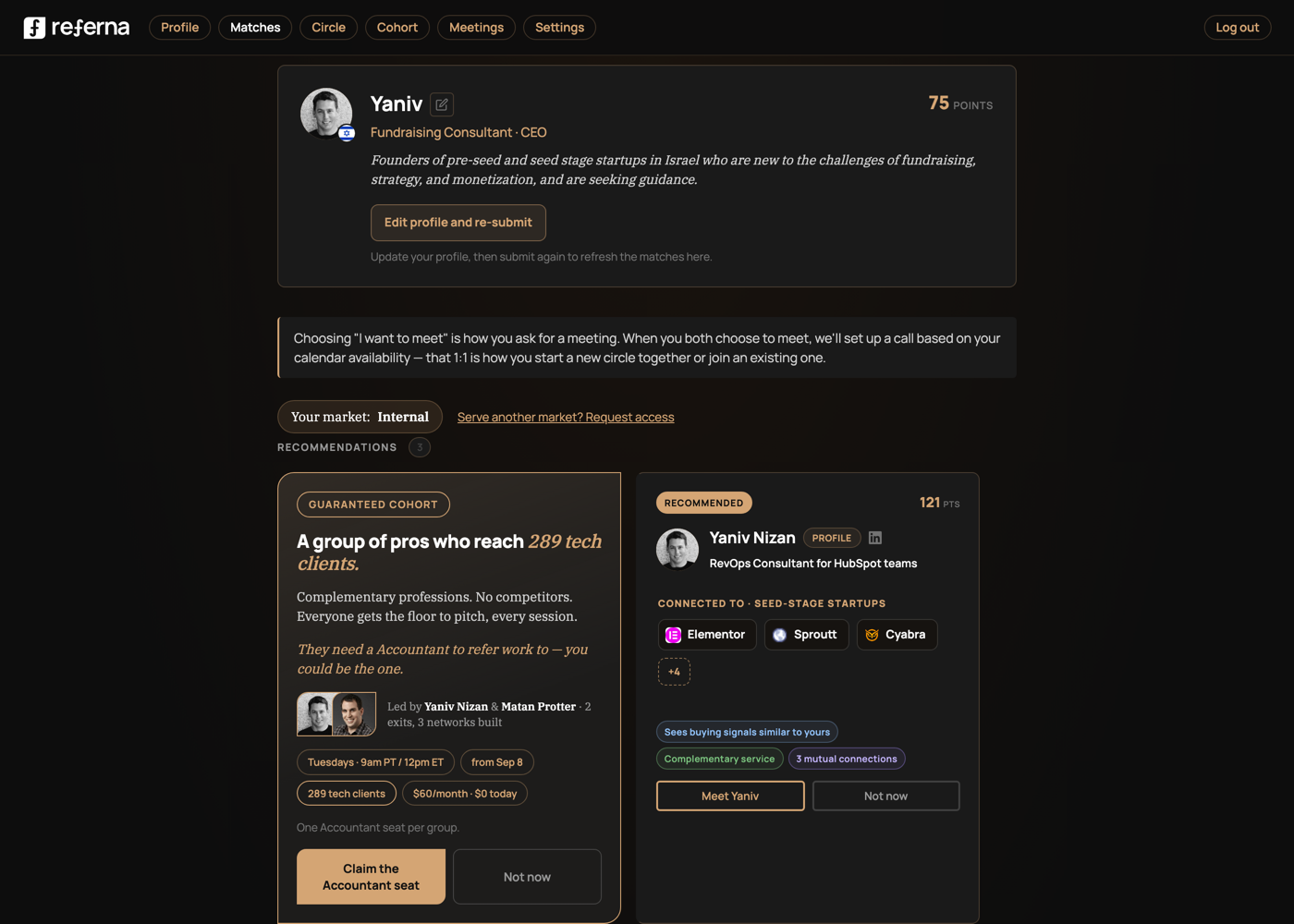
The matches page — the card should show the path to your next client, not a person's bio
Today — real screenshot
Face, profession, timezone; the match reasoning collapsed under "More context." When client data is missing, the code invents a count ("12 of their clients match your ICP," hashed from the person's name).
Proposed — same card, 20% changed
The pills stay; the repeated text goes. One earned claim leads — "Connected to · seed-stage startups" — with real logos, no duplicated counts. CTA becomes "Meet Yaniv." Matching itself should rank by this same number: customers in the viewer's target market.
23
Before / after · Surface 2.1
The expanded profile — same fix, one level deeper
Today — real screenshot
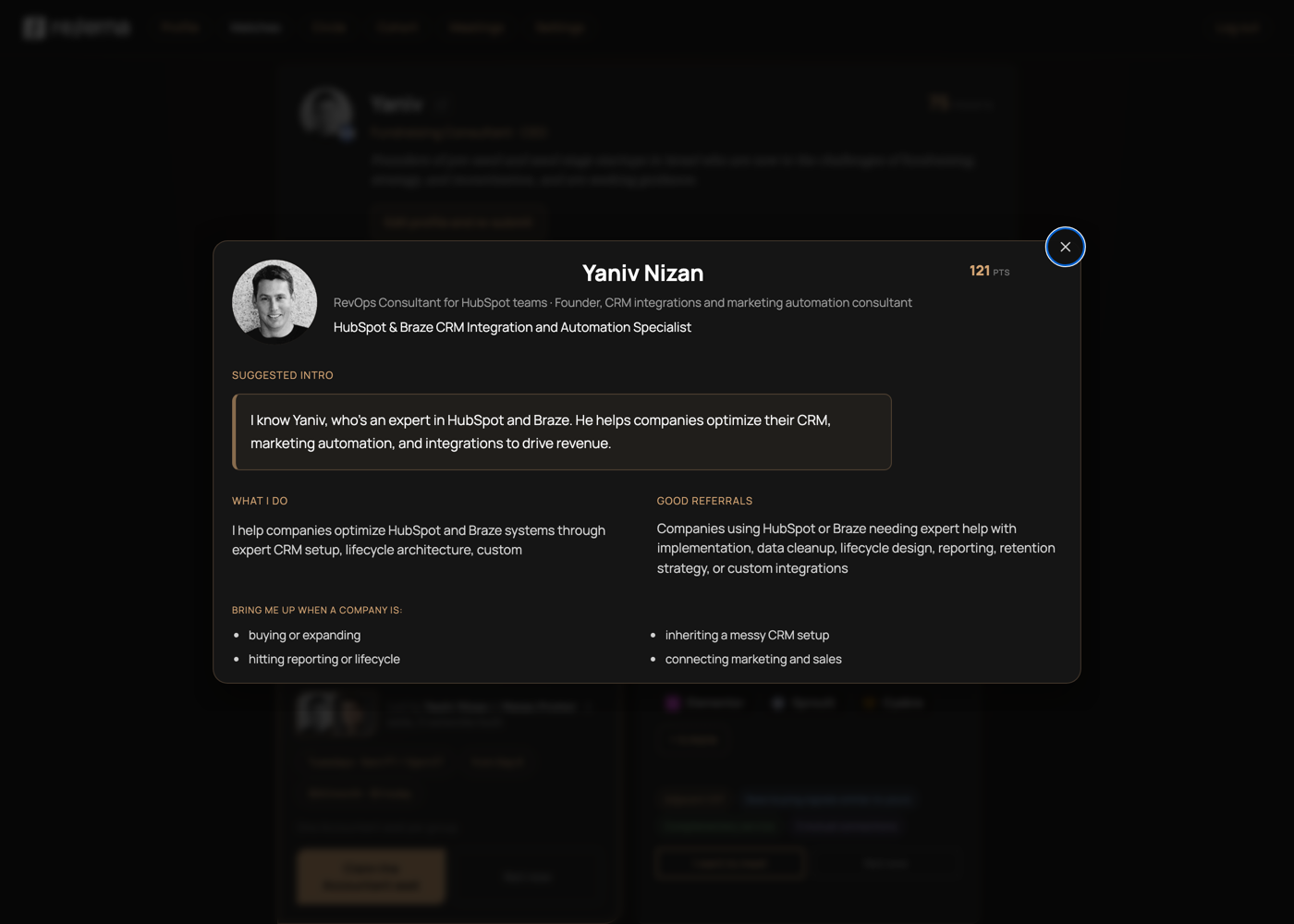
Four prose sections about the person — what I do, good referrals, bring me up when. All words, no evidence.
Proposed — same modal, 20% changed
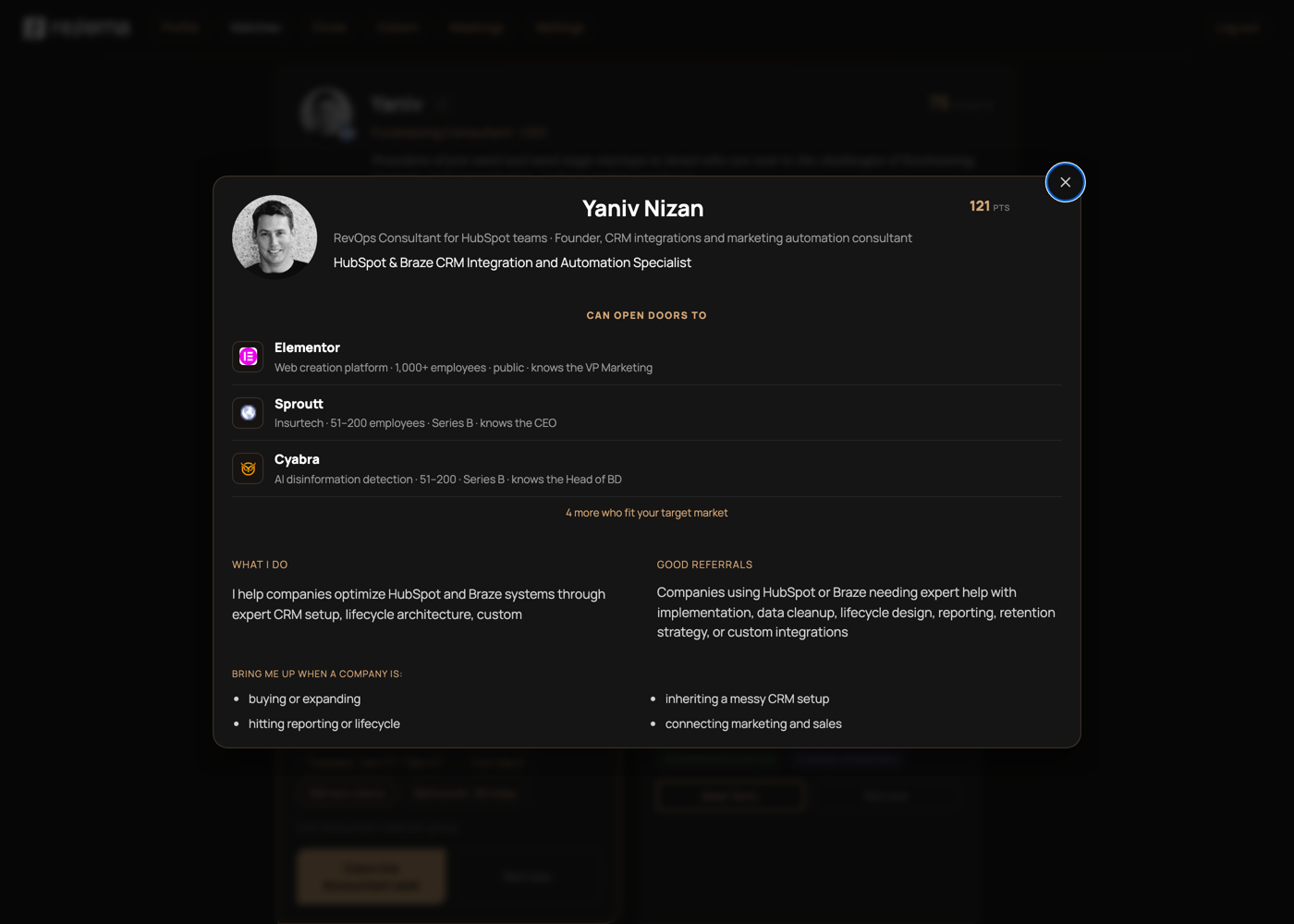
Inside the card, right under the name: per-client rows — logo, company, employee count, funding stage, contact seniority ("knows the CEO"). Suggested-intro prose is gone. "4 more who fit your target market" replaces the vague "revealed after you meet."
24
Before / after · Surface 2.2
The scheduler — booking a call is also the moment to earn it
Today — real screenshot
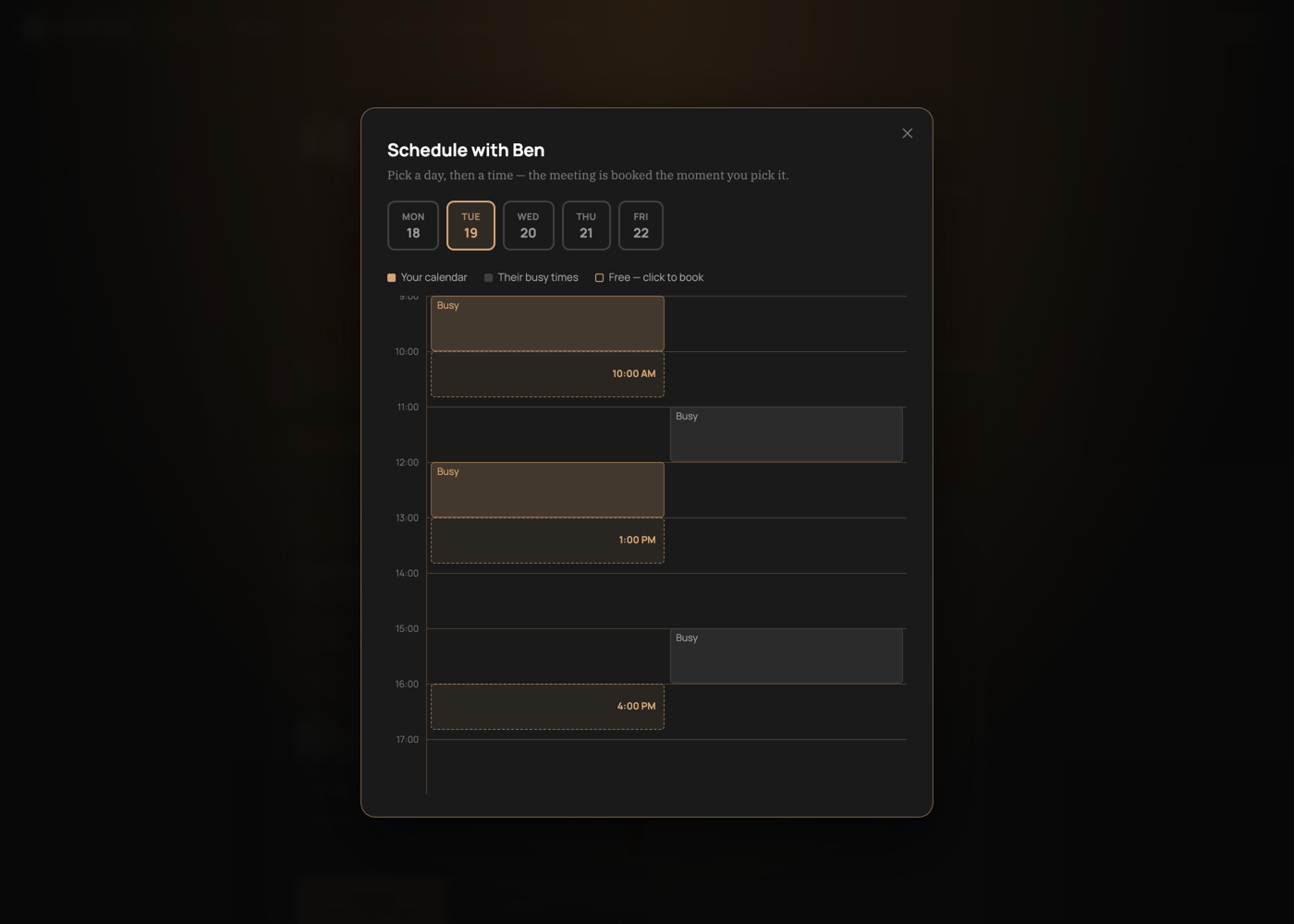
A calendar grid — pick a day, pick a slot. No context on why this meeting is worth either person's time.
Proposed — same picker, 20% changed
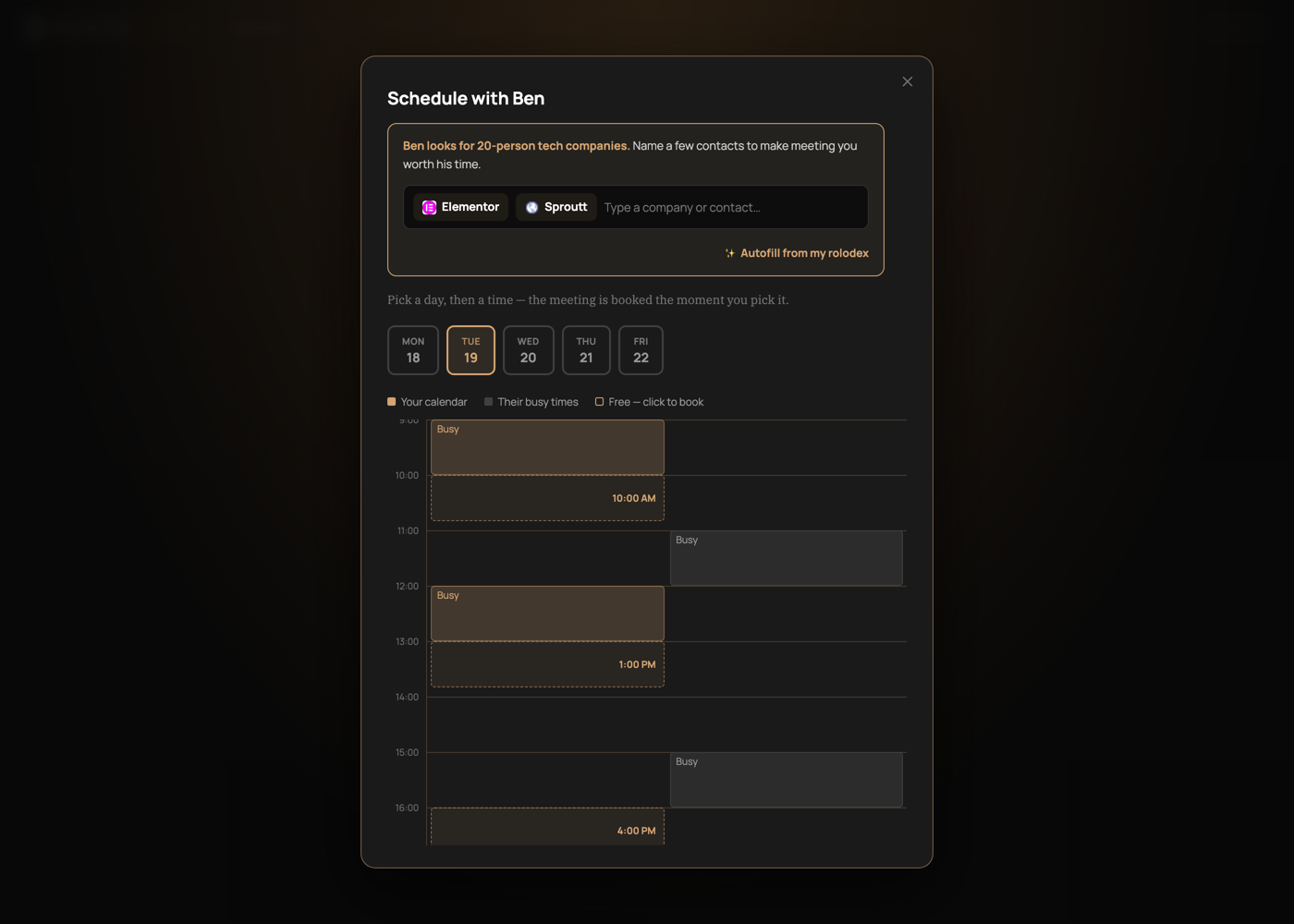
One short, specific prompt: "Ben looks for 20-person tech companies — name a few contacts." An autocomplete field resolves free text to real client chips (logo + name; id and domain stay hidden). "Autofill from my rolodex" pulls from the client list you already built.
25
Before / after · Surface 3
Emails — fifteen recurring templates, zero client-led subject lines
Today — real template, real subject
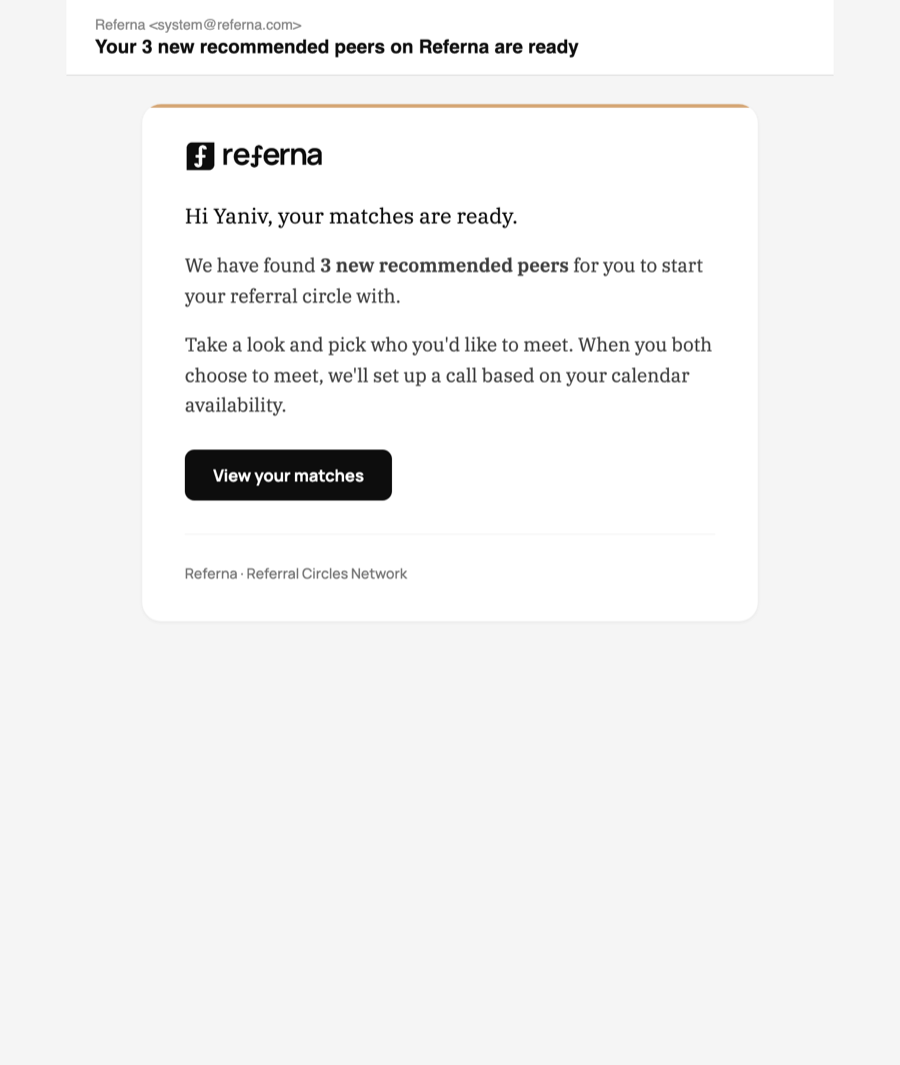
"Your 3 new recommended peers on Referna are ready." Across the entire recurring set, no subject or opening line ever names a client. The highest-frequency surface sells membership upkeep.
Proposed — same template, 20% changed
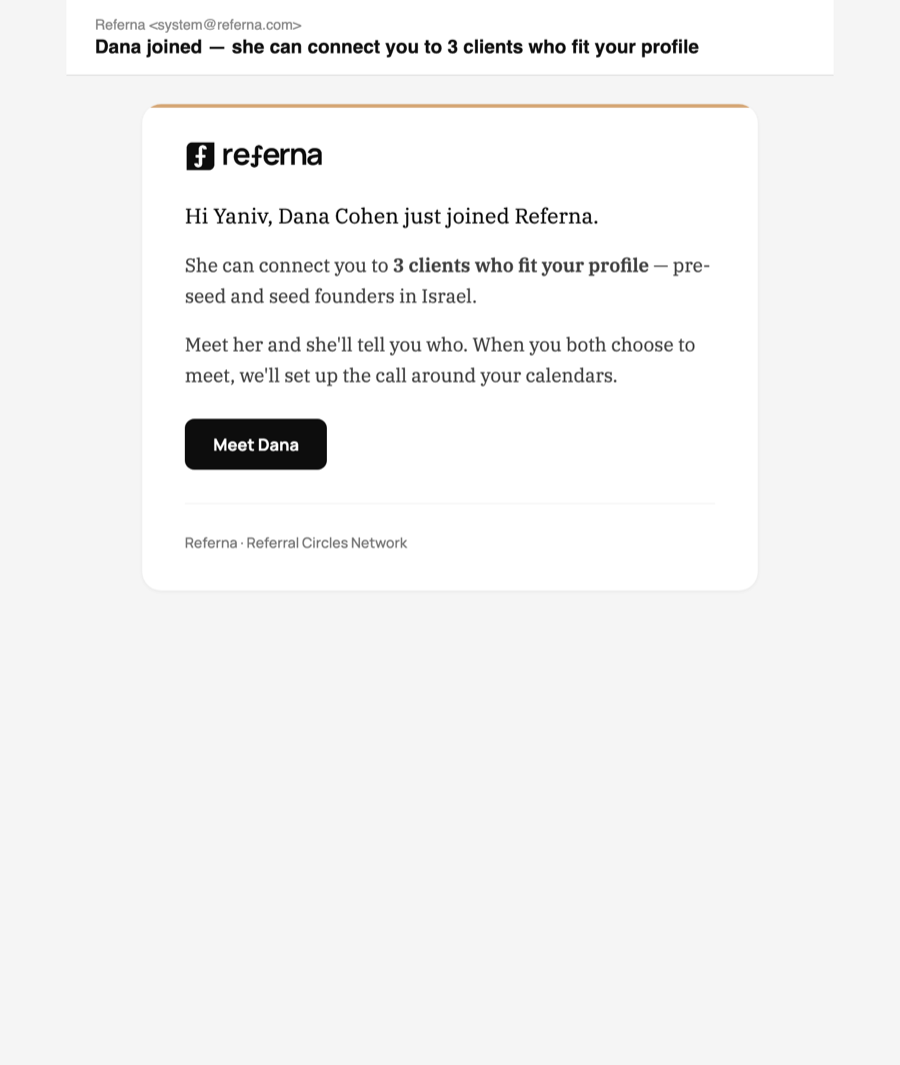
The curiosity hook does the work: "Dana joined — she can connect you to 3 clients who fit your profile." A count, not names — stronger pull, zero data exposure. CTA: "Meet Dana."
26
Before / after · Surface 4
The live meeting — the most spine-aligned surface we have. Keep it. Bank its output.
Today — real meeting room
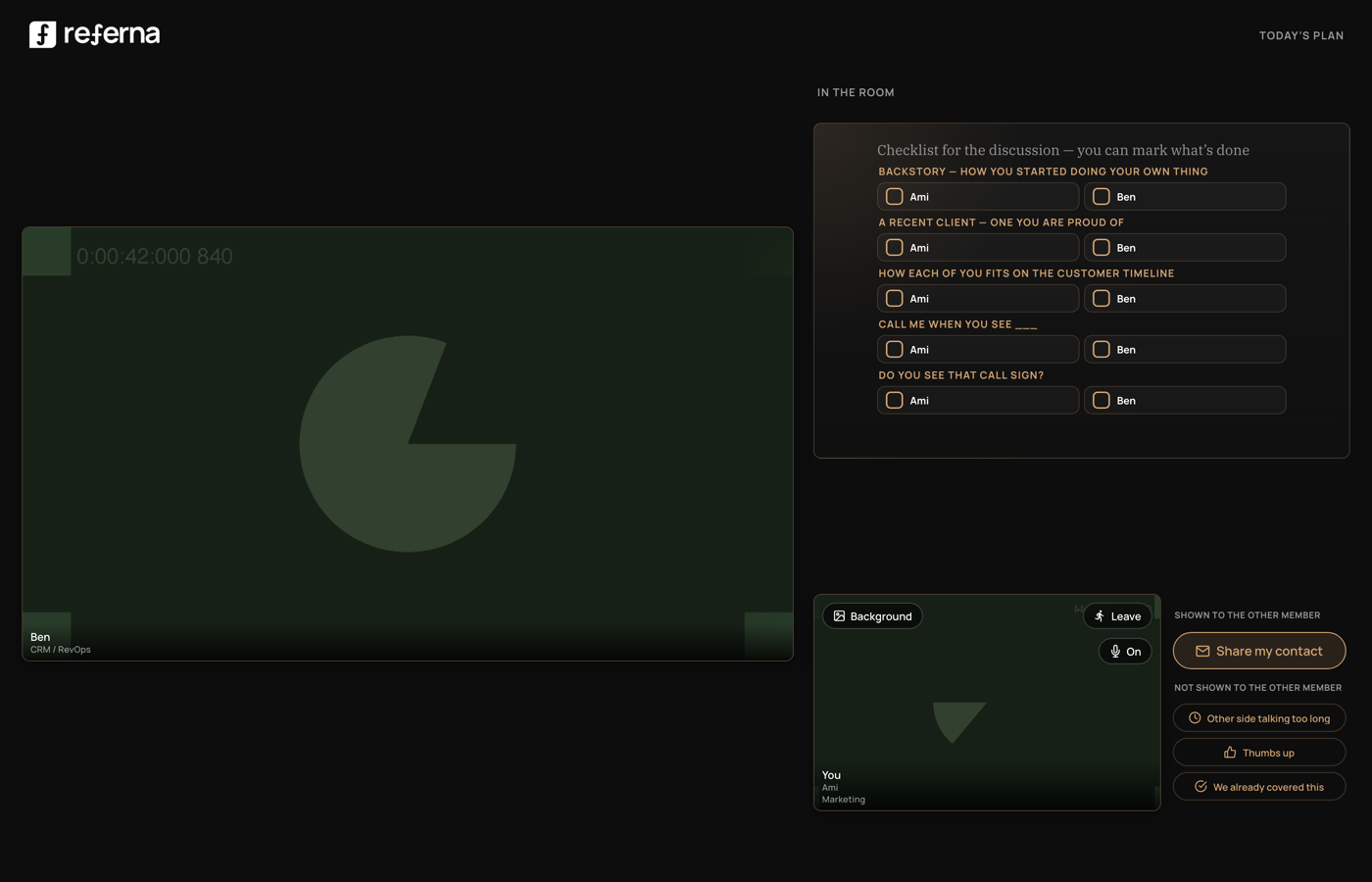
The real two-person room: counterpart video, the five referral rounds. Gordy already runs the call at the client — but everything said here evaporates when the room closes.
Proposed — same room, 20% changed
The counterpart video is top-aligned with the checklist while the self feed stays below it; both remain the real room at its real size. The panel sits directly beneath the counterpart feed. Two boxes, "You mentioned · 2" and "Ben mentioned · 1," real logo chips, light border matching every other card on the page.
27
Implemented · Surface 4.1
The weekly cohort session now turns the room into a live referral engine
Implemented in integration-2 — real live-meeting-agent screen
One member takes the stage while the room maps real companies against that member's client brief. Here, Adobe has already moved into Nina's client bucket — the referral round is now a working interaction, not another item on the agenda.
28
Before / after · Surface 5
The recap email — clients are mentioned, then buried in prose
Today — the real recap email
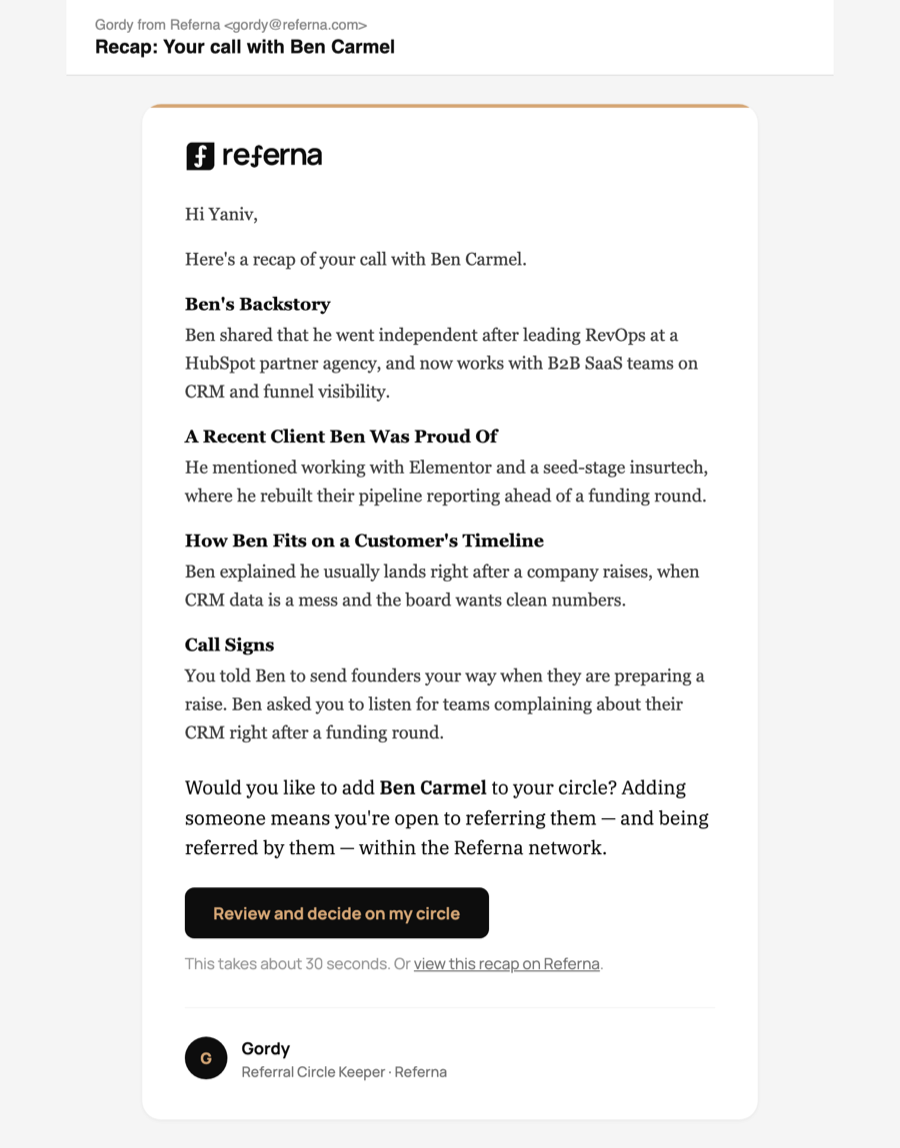
The recap already contains clients — "He mentioned working with Elementor and a seed-stage insurtech" — as sentences in a story. Nothing is extracted, counted, or followed up.
Proposed — same recap, 20% changed
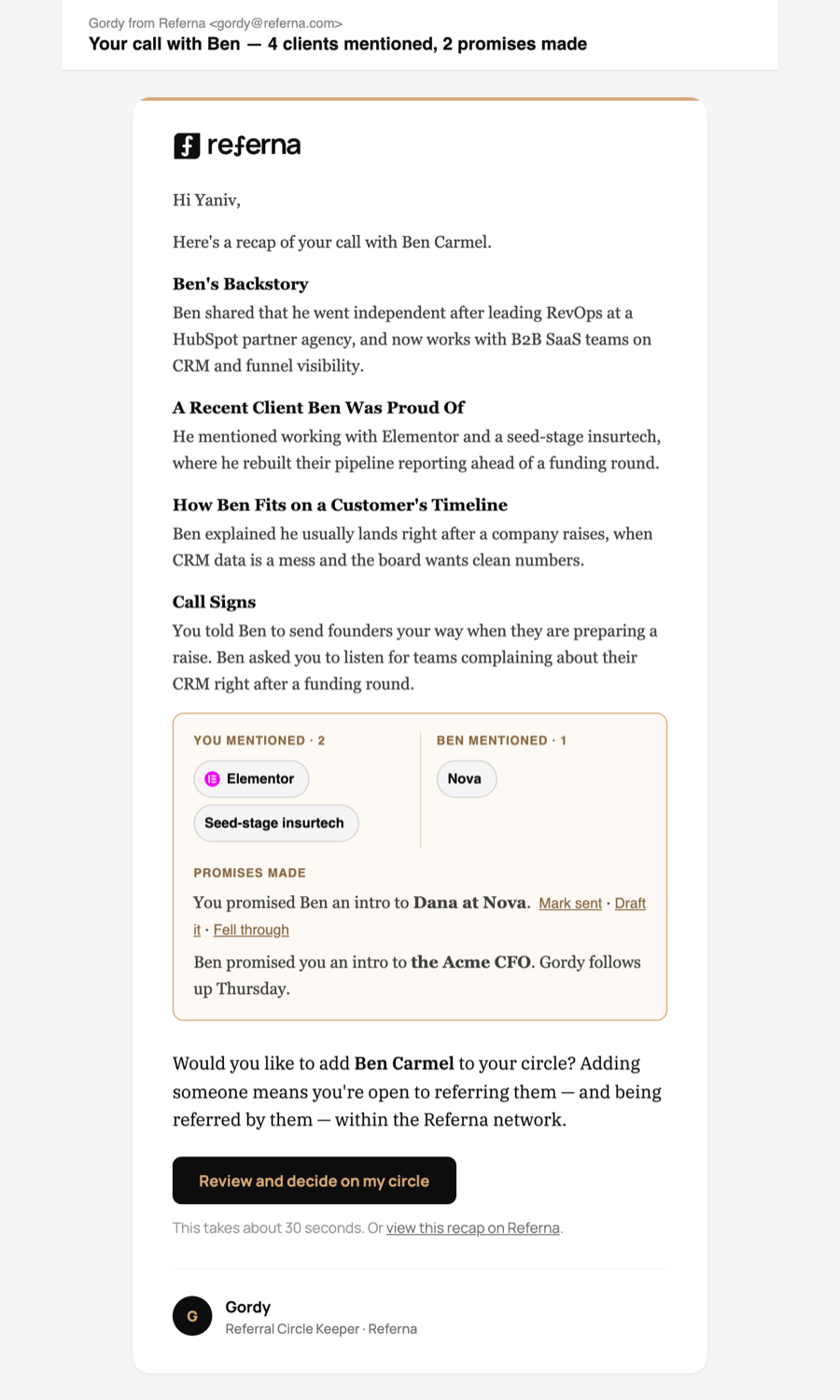
Split by who said it — "You mentioned · 2" and "Ben mentioned · 1" — each as logo chips. Promises get one-tap follow-through, extracted from the full transcript after the call, where detection is reliable.
29
Before / after · Surface 6
The meetings page — recaps that hide the clients they contain
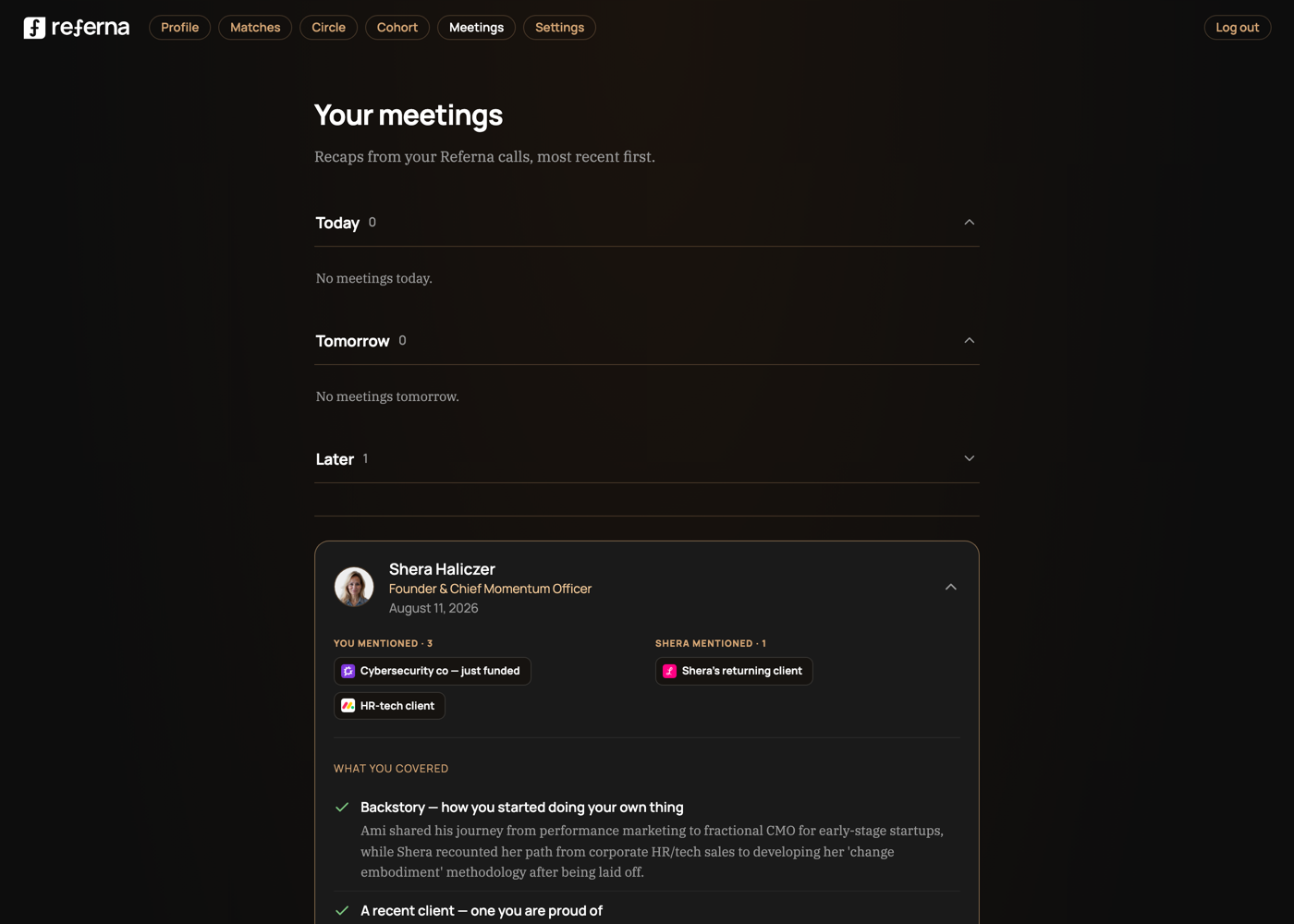
Today — real screenshot
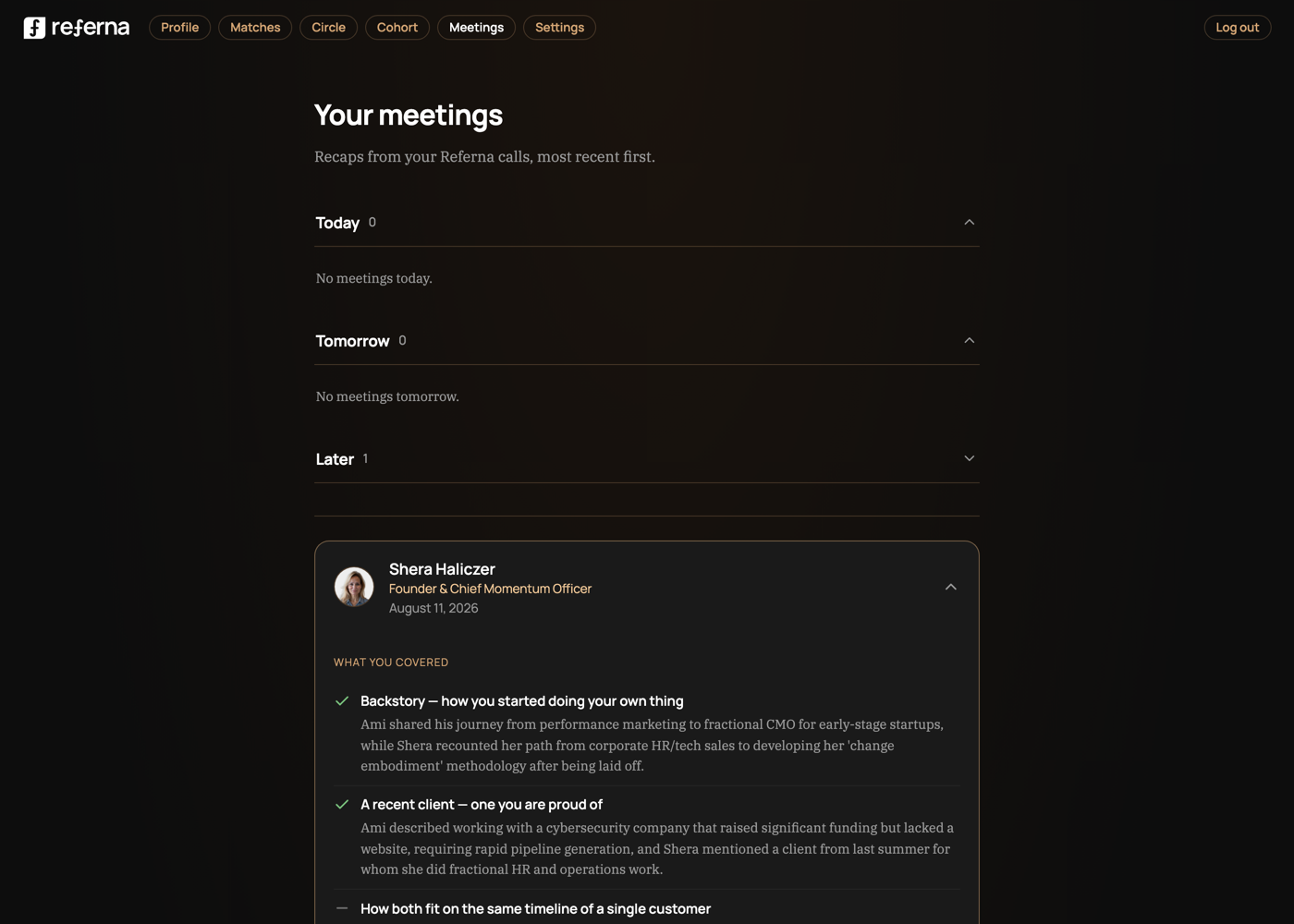
Recaps with per-topic checkmarks. The clients discussed are in the prose — never extracted, never visible at a glance.
Proposed — same page, 20% changed
Same split as the recap email — "You mentioned" and "[Name] mentioned" side by side, same chip style used everywhere else in the deck. The meetings page becomes a ledger of client discovery, not attendance.
30
Before / after · Surface 7
The cohort roster — an attendance sheet that should be a referral market
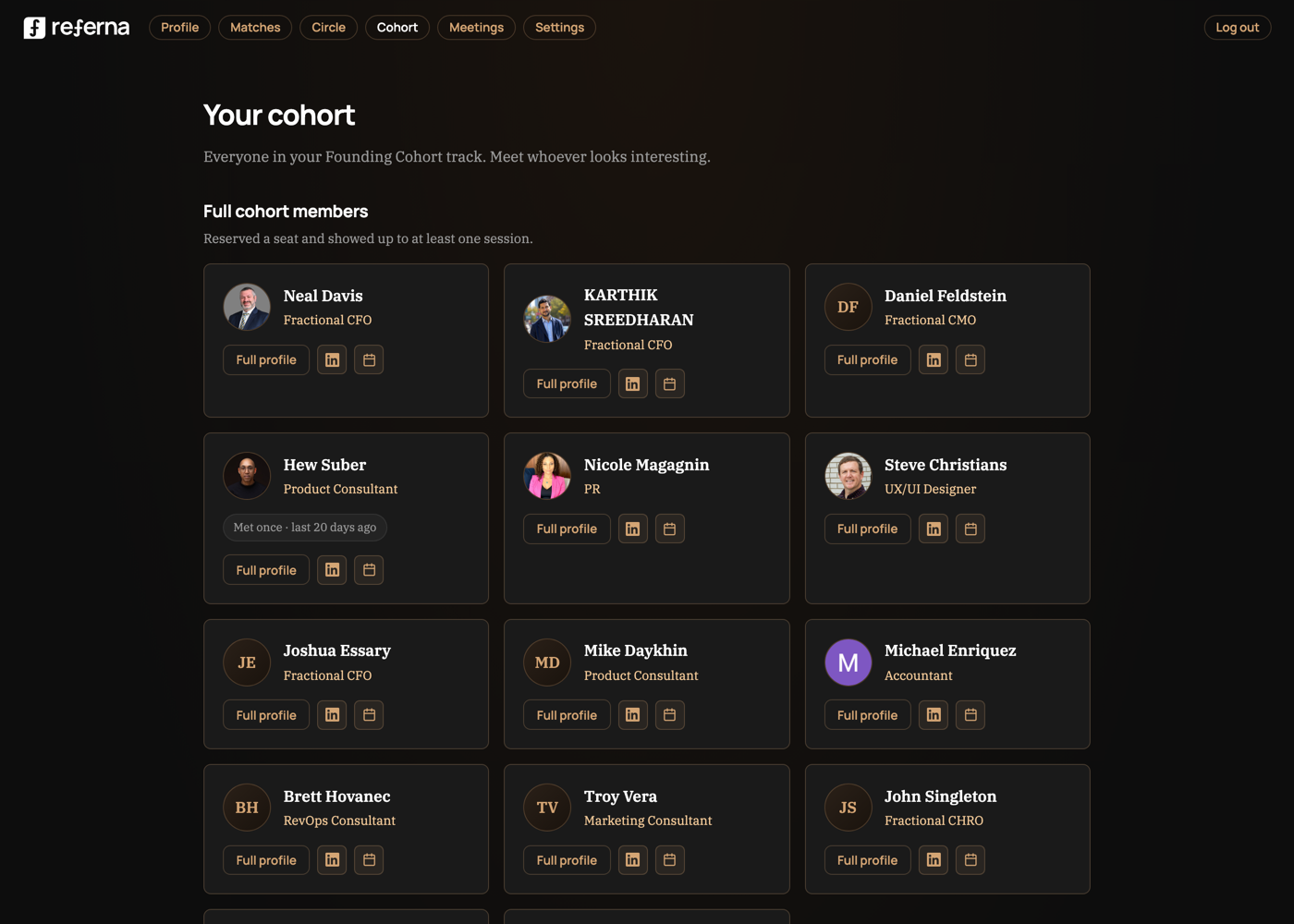
Today — real screenshot
"Meet whoever looks interesting." Cards show photo, profession, and how often you've met — no reach signal anywhere, no summary of what the room is worth.
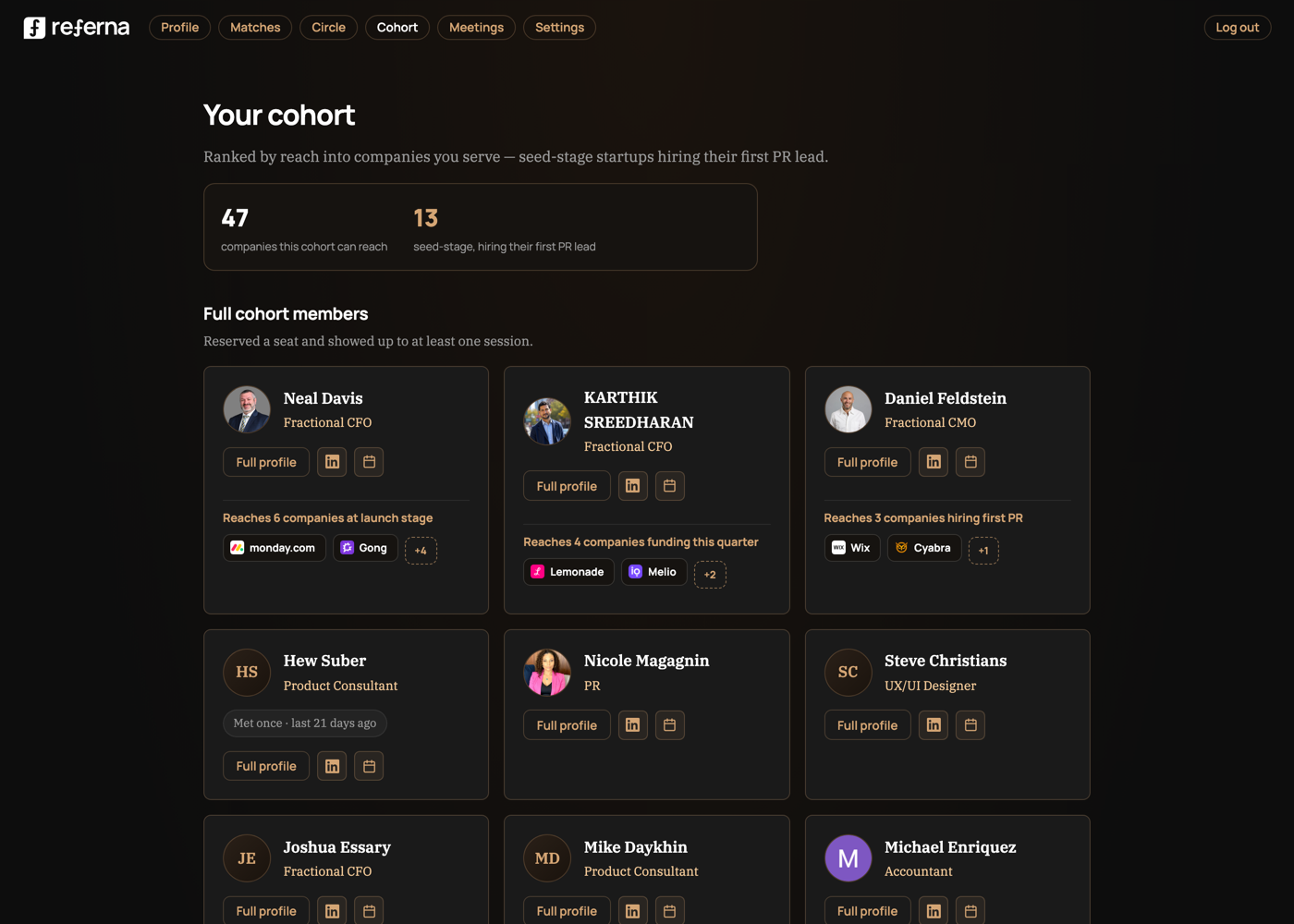
Proposed — same roster, 20% changed
A summary bar leads the page — "47 companies this cohort can reach · 13 seed-stage, hiring their first PR lead" (the viewer's actual criteria, not a placeholder). Every card carries real logos and the same framing: "Reaches N companies at <their stage or trigger>."
31
New · Surface 7.1
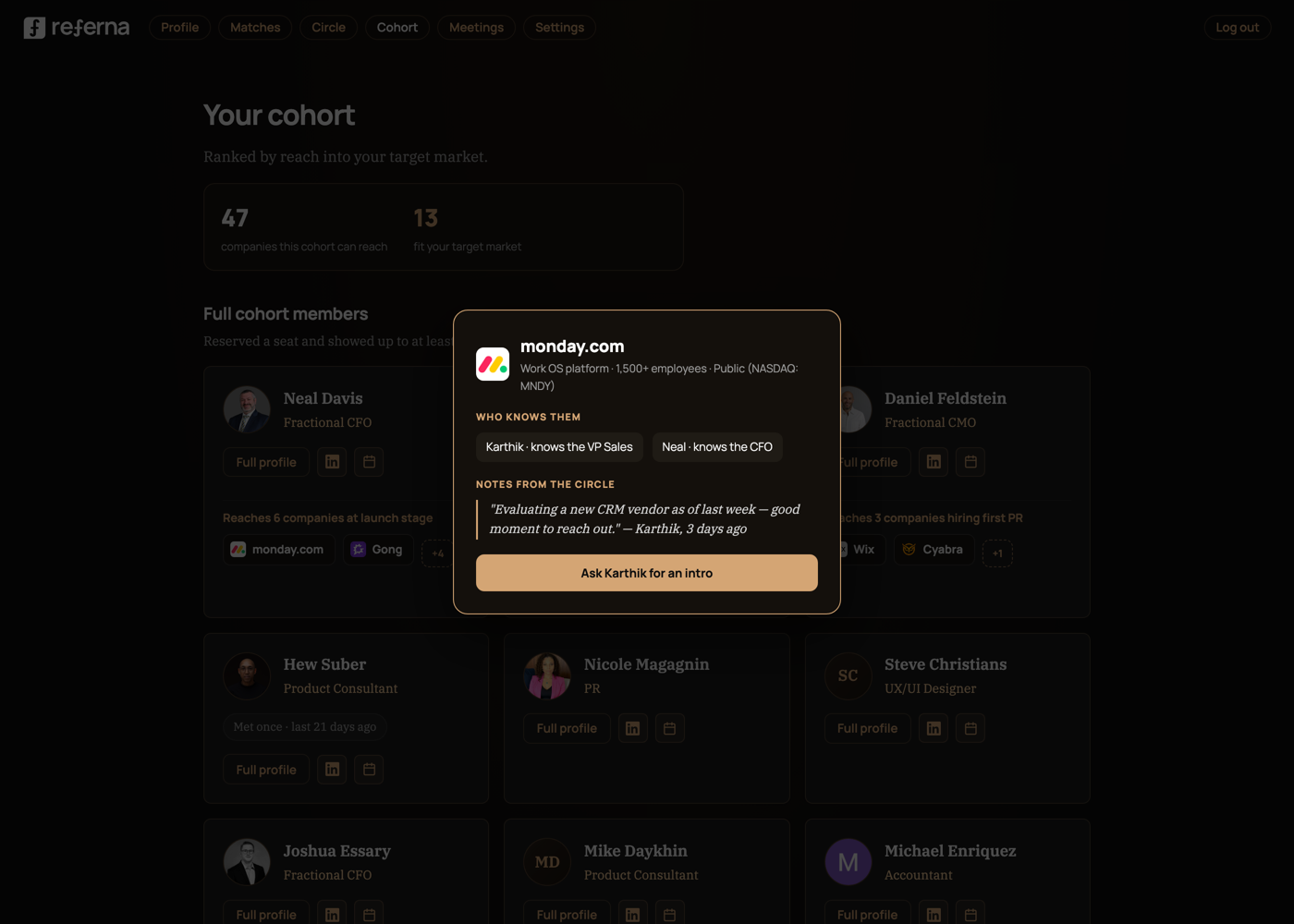
Click a logo — the company becomes a shared record
Proposed — new capability
Clicking any logo opens a collaborative CRM entry for that company: size, ownership, who in the circle knows them and in what role, and freeform notes members leave for each other — "Evaluating a new CRM vendor as of last week." One tap asks the connector for an intro.
32
Before / after · Surface 8
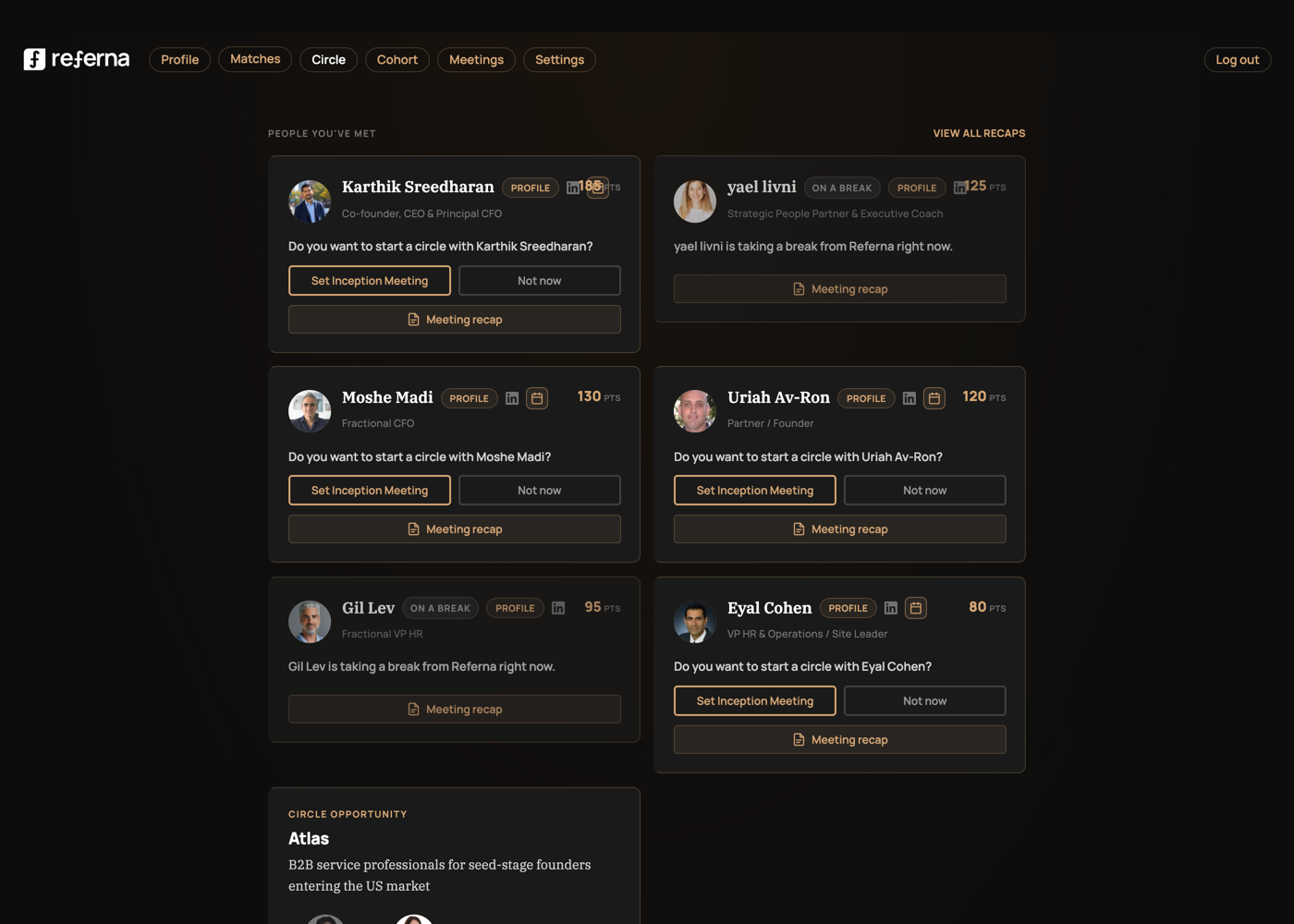
The circle page, pre-circle — where most members actually are
Today — real screenshot (member with no circle)
"People You've Met" cards push one ask — "Set Inception Meeting" — a governance step, before any value has been shown.
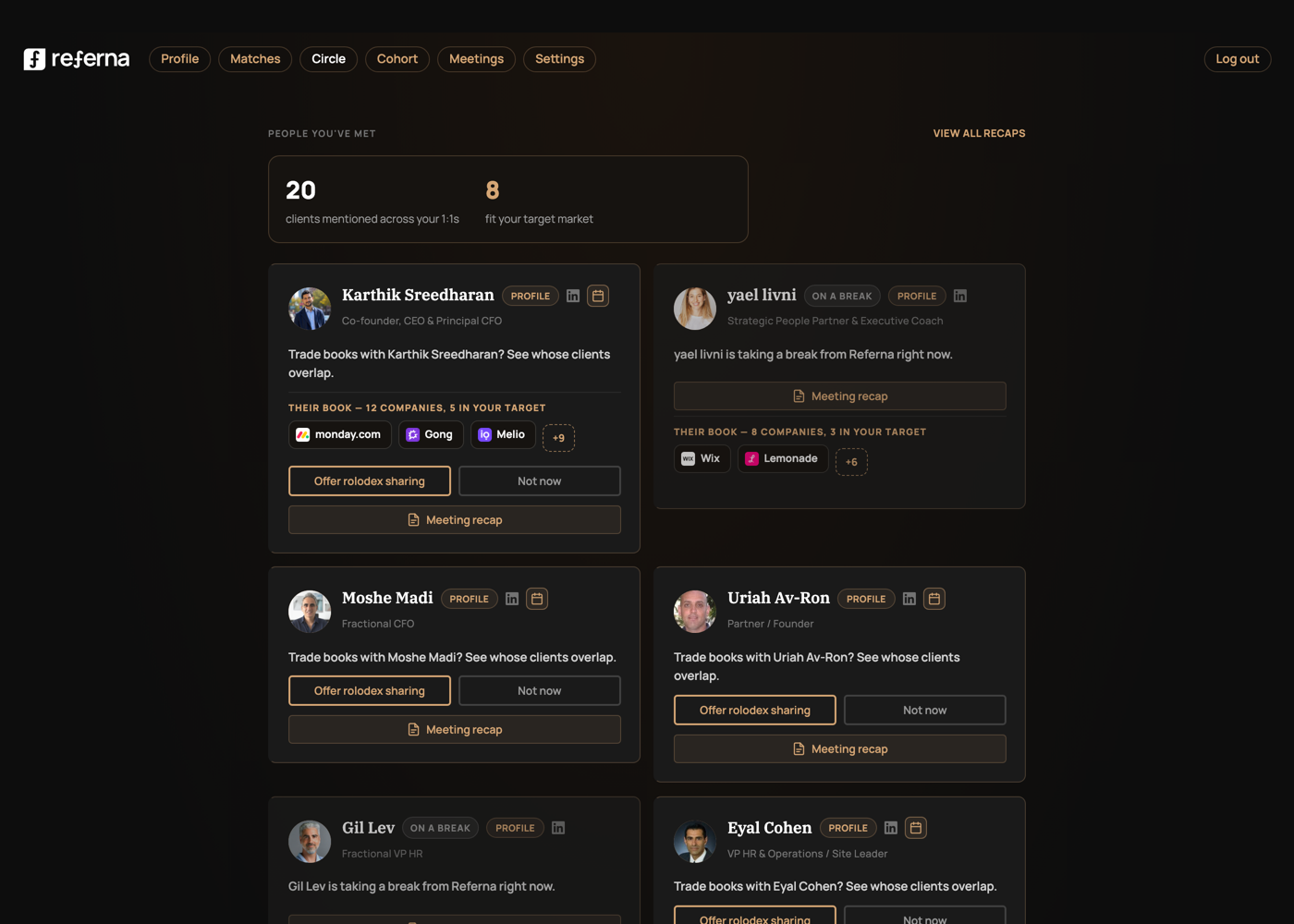
Proposed — same page, 20% changed
A summary bar leads: "20 clients mentioned across your 1:1s · 8 fit your target" — this is what your calls have already surfaced, not a made-up pipeline. Each met person shows their client list; the main action becomes "Offer rolodex sharing."
33
New · Surface 9
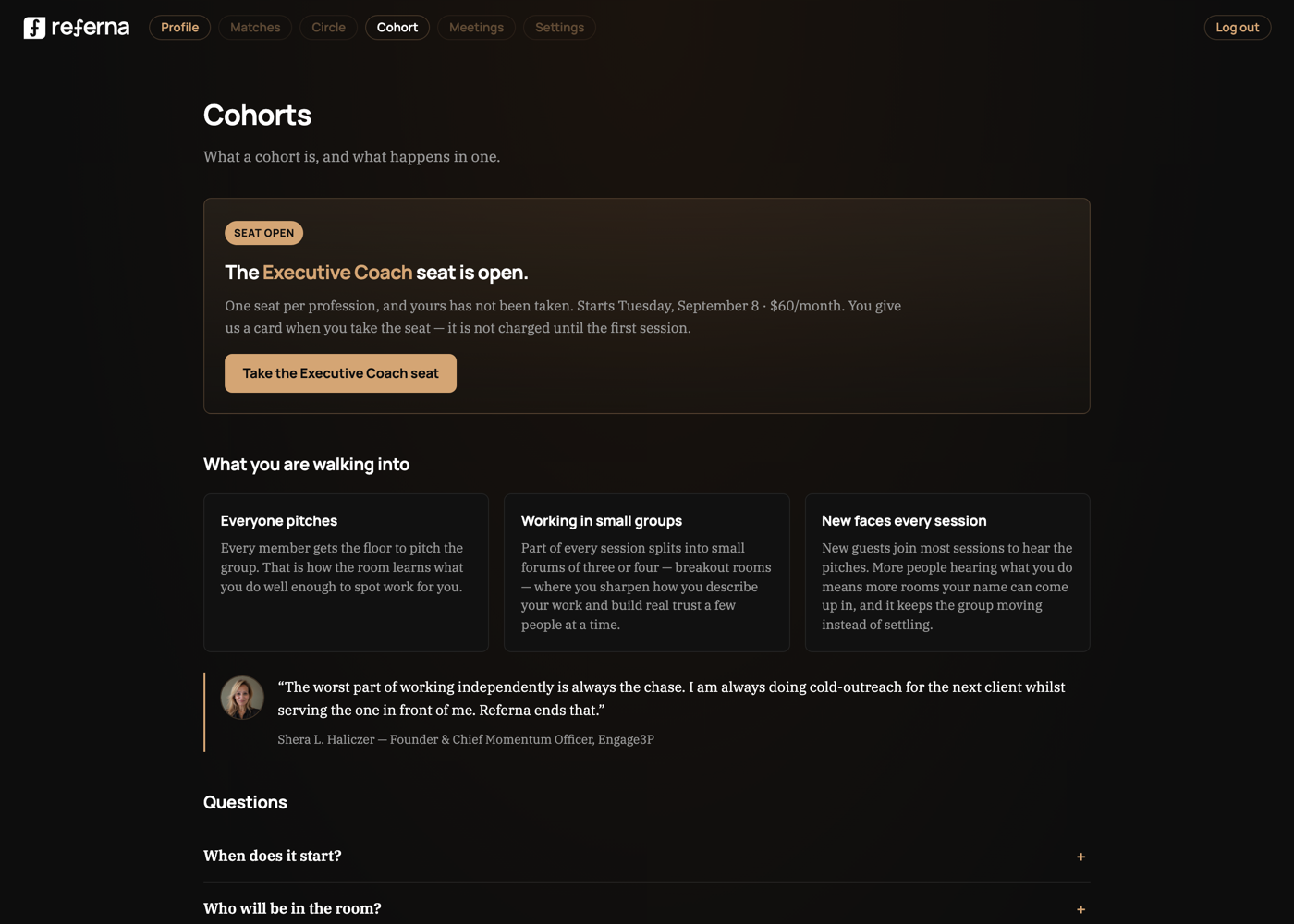
The cohort page, before you're even in one
Today — real screenshot (member with an open seat)
"The Executive Coach seat is open." One column, one claim: headcount and price. Nothing about who is in the room.
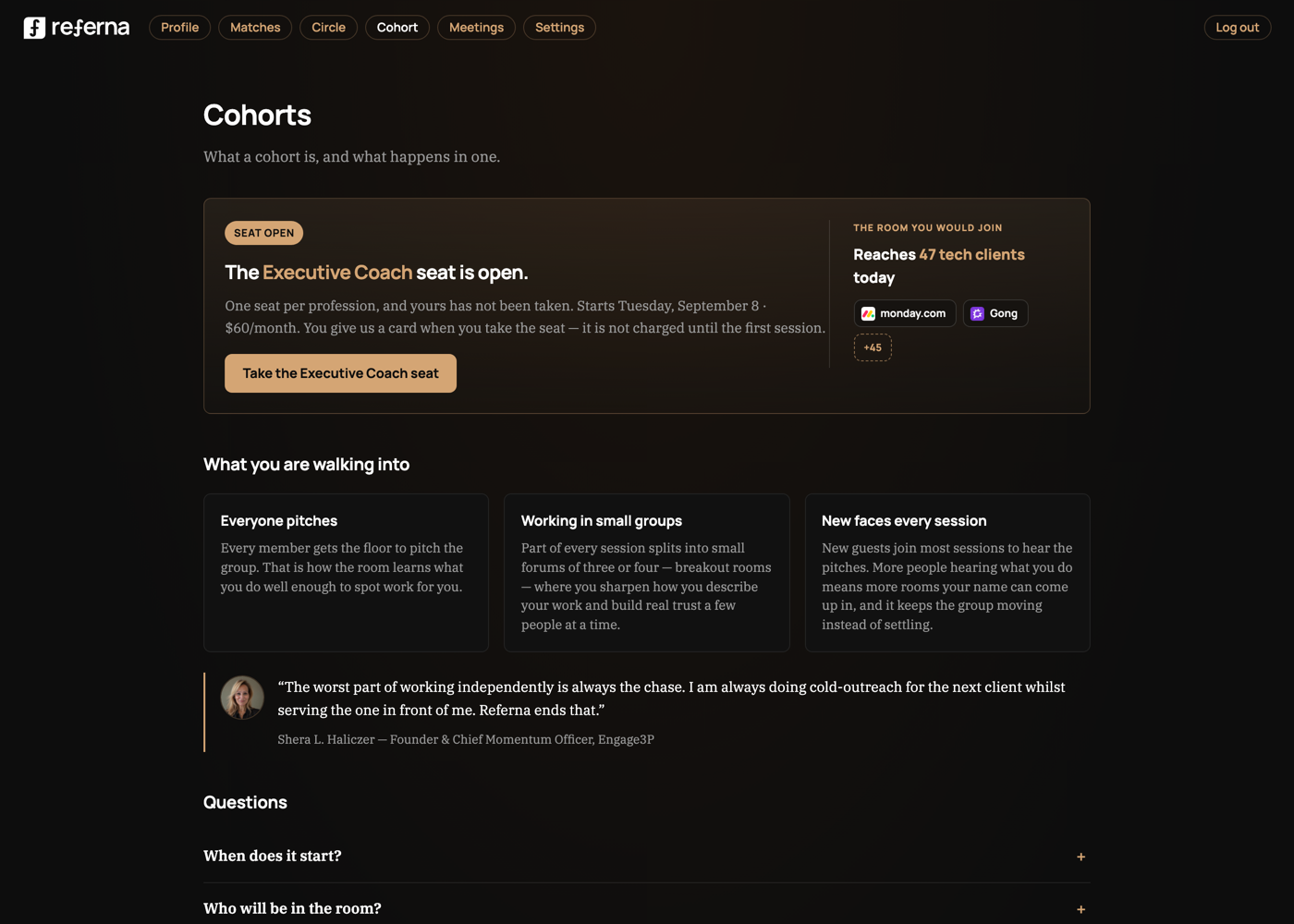
Proposed — same panel, 20% changed
Two columns inside the same bordered panel — no box inside a box. Left: the existing offer. Right: "Reaches 47 tech clients today" with real logos, so the room's value shows before you take the seat.
34
New · Surface 10
The cohort seat promo — "20 peers" is weaker than what they can reach
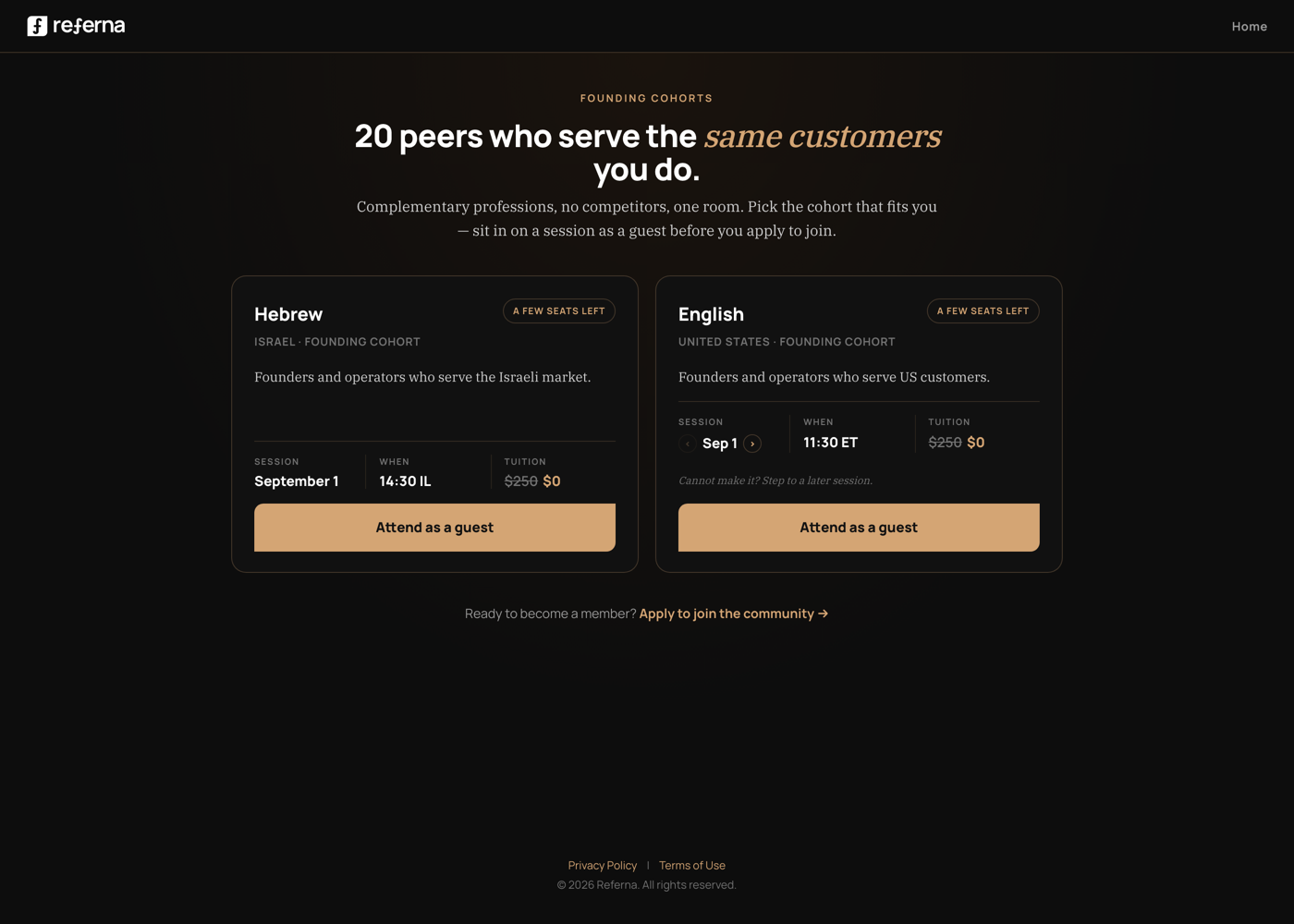
Today — real screenshot
"20 peers who serve the same customers you do." A headcount claim — how many people, not which clients.
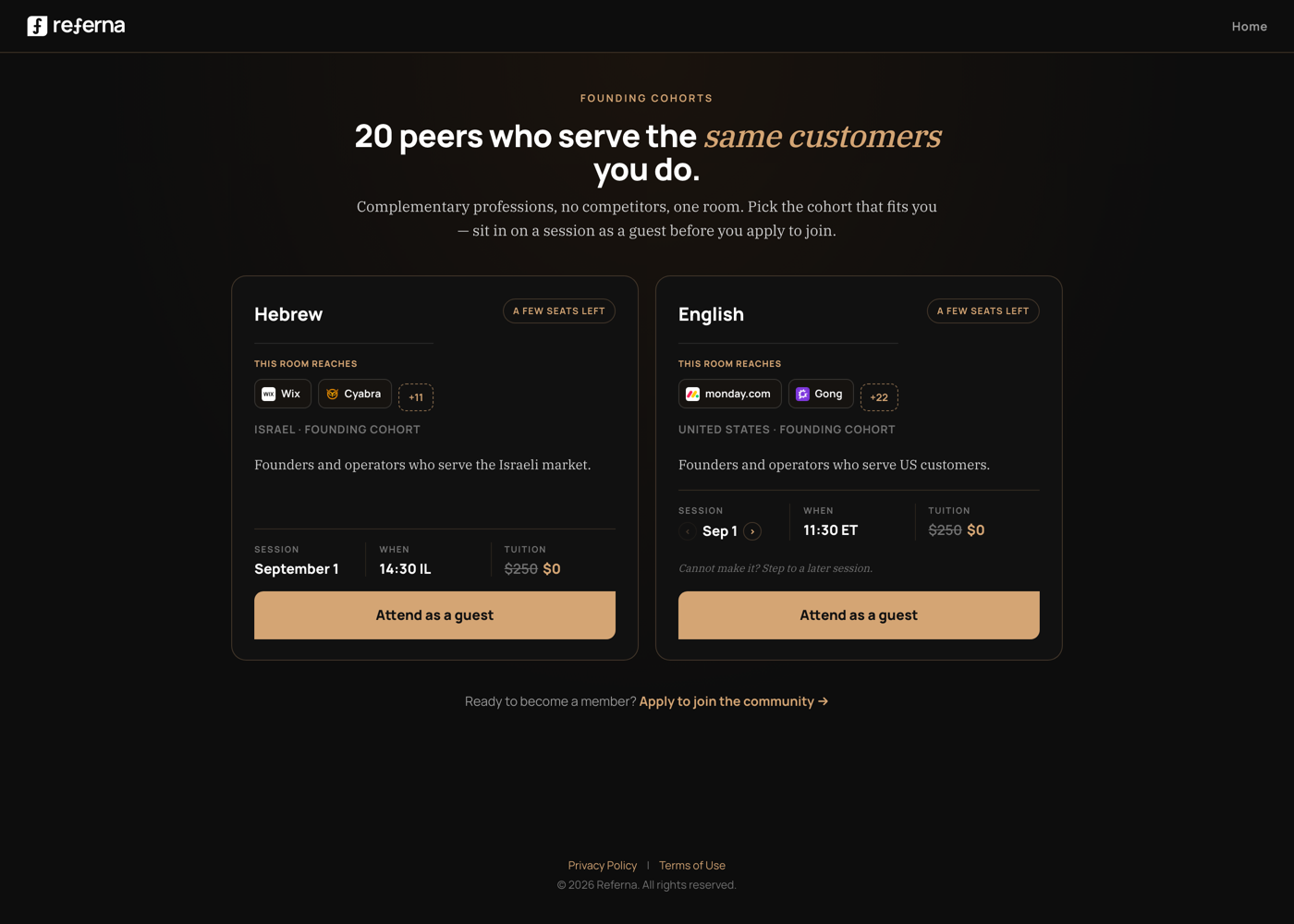
Proposed — same page, 20% changed
Each cohort card carries its own logos — not a shared block above both. Hebrew reaches Wix and Cyabra; English reaches monday.com and Gong. Each room is sold on the clients actually in it, not a generic claim applied to both.
35
Measuring the spine
Referral is the opposite of pipeline. Count reach, not follow-ups.
Pipeline is managing people who came to you at the wrong time. Referral is having people who know exactly when to send you someone ready to buy.
D
Clients discovered per member
The client list: relationships mapped from calendars, contacts, onboarding, every call. Today this data exists and is thrown away.
M
Clients mentioned per call
Every 1:1, group session, and mixer already surfaces clients in conversation. Count them, show them, keep them.
R
Reach: who can mention your name
How many people remember you, in front of how many customers in your target market — the number every circle, roster, and profile should lead with.
C
Referred clients landed
The goose itself — reported through the thank-you flow that already exists. No stages, no follow-up hygiene, no pipeline.